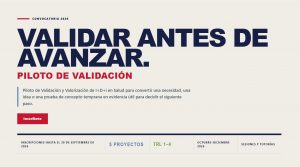
Health R&D&I Validation and Value Assessment Pilot «Validate Before You Advance»
28 September 2026
ISABIAL is launching this pilot programme to support five health research projects at a key stage of validation, value assessment and decision-making, with the collaboration of the University of Alicante (UA) and Miguel Hernández University of Elche (UMH).
What is it?
A validation and decision-making stage. In the early stages of a research project, many questions can arise: does the solution address a real need? Who will use it? What evidence is needed? Is it viable from a clinical, technological and regulatory perspective? Are there opportunities for adoption or knowledge transfer?
The Health R&D&I Validation and Value Assessment Pilot, “Validate Before You Advance”, has been created to help research teams answer these questions and generate evidence before undertaking further development or significant investment.
The programme is structured around four steps:
- 01 · Define: Clarify the need, the users and the problem that needs to be addressed.
- 02 · Validate: Gather evidence through interviews, stakeholder analysis and a review of the relevant landscape.
- 03 · Assess value: Review the value proposition, the initial value case and potential routes for value creation and knowledge transfer.
- 04 · Decide: Develop a realistic roadmap to move forward, pivot or generate further evidence.
Who is it for?
Research projects addressing real-world healthcare needs.
The programme is aimed at projects in the early stages of development, with the potential to progress towards clinical practice, value creation or knowledge transfer.
Projects must meet the following requirements:
- Technological maturity: Projects at TRL 1–4, from initial research or formulation through to proof of concept or early-stage validation.
- Healthcare application: Projects related to healthcare, diagnosis, prevention, healthcare training, healthcare organisation, or biomedical and digital technologies.
- Potential for further development: Potential for value creation, knowledge transfer, adoption or further development.
- Team commitment: Availability to participate in sessions, mentoring and work between meetings.
- Connection with ISABIAL: At least one researcher involved in the project must be affiliated with or attached to ISABIAL.
What will be addressed?
During the programme, each project will be assessed from four complementary perspectives:
- 01 · Clinical: Need, user, value and fit within healthcare practice.
- 02 · Market: Customer, decision-maker, alternatives and adoption opportunities.
- 03 · Regulatory: Requirements, risks and evidence needed.
- 04 · Technology: Maturity, feasibility and technical risks.
Timeline
October–December 2026. The programme will combine mentoring sessions, technical sessions and online tutorials, with work between meetings to advance the validation of each project.
October
- Kick-off and problem framing: Initial session and definition of the work plan.
- First mentoring session: Review of initial progress and resolution of questions.
- User and value proposition: Work on users, needs and the value proposition.
- Clinical and regulatory validation: Review of the main clinical and regulatory aspects.
November
- Market evidence and fit: Analysis of the landscape, stakeholders and adoption opportunities.
- Second mentoring session: Review of progress and guidance for the next stage.
- From fit to value case: Development and validation of the initial value case.
- Value creation and knowledge transfer: Analysis of potential routes for value creation and knowledge transfer.
- Third mentoring session: Preparation of conclusions and next steps.
December
- Communication, presentation and next steps: Closing of the programme, presentation of results and definition of the roadmap.
What will each project gain?
Evidence to support better decisions. Each project will complete the pilot with a practical summary of the work carried out and clear guidance on its next steps.
The process will provide:
- A clearer definition of the need and problem.
- Validated hypotheses and identification of those that still require further validation.
- A refined value proposition.
- Identification of the main clinical, regulatory and technological risks.
- An initial value case.
- Guidance on potential routes for value creation and knowledge transfer.
- A roadmap with key milestones and required resources.
- Criteria to determine whether to move forward, pivot or generate further evidence.
Does your project need evidence before taking the next step?
If you have an early-stage health research project and want to assess its potential before moving forward, you can apply to the pilot programme.
5 projects · TRL 1–4 · October–December 2026
📅 Applications open until 30 September 2026
More information: piloto.isabial.es