Cutting-Edge Technology Set to Revolutionise Neurosurgery: The Project Locating Brain Tumours in Real Time
Proyectos autonómicos, Regional Projects
1 October 2026
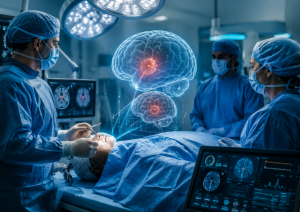 The tool, called BRAINDERSY, combines low-power microwaves, digital twins and augmented reality to assist the medical team in the operating theatre.
Led by Miguel Hernández University of Elche (UMH), the initiative has received financial support from the Generalitat through Ivace+i Innovación and European ERDF funds.
The success of an operation to remove a brain tumour is measured in millimetres. Today, these complex procedures are planned with extreme precision days before entering the operating theatre, using high-resolution magnetic resonance imaging or computed tomography scans. However, once the neurosurgical team performs the craniotomy, the situation can change dramatically.
Due to changes in pressure and other physiological factors, the brain usually undergoes physical displacement within the skull, a clinical phenomenon known as brain shift. This movement alters the actual position of the tumour compared with the initial surgical plan. Until now, surgeons have had to rely mainly on their own experience and clinical judgement to estimate this variation, as there were no tools capable of measuring it objectively and quantitatively during the operation.
To address this major medical and technological challenge, BRAINDERSY was launched as a pioneering project led by Miguel Hernández University of Elche (UMH) — through its Elche Microwave Laboratory research group, EMwLab — with the collaboration of several organisations from the Valencian innovation ecosystem.
A microwave helmet and digital twins to guide the surgeon
BRAINDERSY’s technology stands out for being safe, fast and highly accurate. The system is based on Medical Microwave Imaging, a non-invasive technique that safely analyses biological tissues.
The procedure is structured around three key stages:
- The digital twin: Days before surgery, a personalised three-dimensional virtual model of the patient’s skull and brain is generated using their previous medical images.
- Measurement using microwave technology: In the operating theatre, a special helmet equipped with antennas is used to emit very low-power electromagnetic signals — up to one hundred times lower than those emitted by a mobile phone, ensuring that they are completely harmless to both the patient and healthcare staff. Only two rapid measurements are taken: one before accessing the brain and another immediately after the skull is opened.
- Mathematical processing and augmented reality: In less than five minutes, a series of advanced mathematical algorithms compares both measurements and calculates the tumour’s new location with millimetre-level accuracy.
All this information is immediately displayed to the neurosurgeon through a touchscreen and augmented reality systems, allowing the original position and the updated actual position of the tumour to be viewed simultaneously in 3D. This facilitates informed, rapid and objective decision-making in the operating theatre, reducing the need for costly and complex additional imaging tests during surgery.
A fast, safe and cost-effective alternative
In addition to its clinical value in improving patient safety, BRAINDERSY offers a clear economic advantage. By relying on microwave technology, the platform provides a substantially more affordable and agile alternative to other advanced intraoperative medical imaging systems.
The research team is currently working on the integration and optimisation of the different electronic, software and visualisation subsystems. The objective for the coming months is to have a fully functional demonstrator that faithfully replicates the environment of a real operating theatre in order to validate the combined operation of all its components.
Strategic collaboration within the innovation ecosystem
The development of BRAINDERSY is a clear example of successful knowledge transfer through collaboration between academia, technology centres and private companies:
- UMH (Miguel Hernández University of Elche): Coordinates the consortium and leads the technology for detecting brain displacement, the development of mathematical algorithms and augmented reality tools.
- AITEX: Has designed and manufactured the measurement helmet using specific materials that optimise the propagation and reception of electromagnetic signals.
- ITE (Energy Technology Institute): Is responsible for electromagnetic compatibility testing and providing technical advice to ensure the proper integration of the electronics.
- NEUROINNOVA S.L.: Provides clinical and instrumentation expertise. This company, made up of neurosurgery specialists, advises the engineers on the usability and functionality of the system under real operating conditions.
- Ayming: Actively contributes to dissemination, technology transfer and the strategy for the future commercial exploitation of the research results.
An alliance for innovation in healthcare
This project is being developed with financial support from the Regional Ministry of Industry, Tourism, Innovation and Commerce, headed by Marián Cano, through Ivace+i Innovación. It is also co-financed by the European Union through the ERDF Comunitat Valenciana 2021–2027 programme.
The initiative is closely aligned with the priorities of the Specialised Strategic Innovation Committee for Health and with the priorities of the Valencian Community’s Smart Specialisation Strategy (S3), consolidating the region’s position as a leading hub for cutting-edge healthcare technologies applied to precision medicine.