Sustainable Water Management and the Transition to a Circular Economy Take Centre Stage at Elche Event
Eventos y Ferias, Events and Trade Fairs, Knowledge Offer, Oferta Tecnológica
4 September 2026
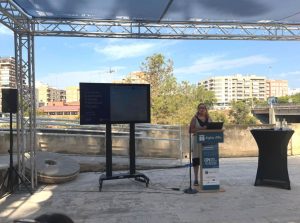 Sustainable water resource management and the transition towards a circular economy were the focus of an event held on 29 June at the Molí del Real in Elche, organised by Aigües d’Elx, with the active participation of the Knowledge Transfer Service of Miguel Hernández University of Elche (UMH).
The event provided the setting for the presentation of the “Sustainable Development and Circular Economy Report in Elche”, a study assessing the state of the urban agenda at national and European level in order to identify good practices and trends that could be applied to the municipality. The study was prepared by the UMH Science Park (PCUMH), in collaboration with the UMH research group Economía, Política i Desenvolupament Agroambiental i del Medi Rural and the UMH Knowledge Transfer Service. It was presented by Begoña Galiana, Business and Institutional Relations Officer at the PCUMH.
A diagnosis to support local action
The report analyses the sustainability situation in the municipality of Elche through three central pillars:
- Municipal assessment: Evaluation of Elche’s current situation in terms of the circular economy and efficient resource use.
- Strategic alignment: Proposal of policies aligned with the Spanish Urban Agenda and European frameworks.
- Indicators and KPIs: Definition of key metrics to monitor actions in Elche and assess their potential applicability to other municipalities.
Challenges in the water sector: an opportunity for UMH R&D&I
During the event, Aigües d’Elx presented its new Innovative Public Procurement (IPP) Guide and provided details of the Preliminary Market Consultation (PMC) focused on “Advanced treatment of pollutants and comprehensive resource valorisation in the water cycle”.
The challenges identified by the water utility provide an ideal opportunity to connect the sector’s needs with the scientific and technological capabilities of UMH research groups. The priorities presented included:
- Emerging contaminants and nutrients: Removal of PFAS, pharmaceuticals, microplastics and heavy metals, together with the recovery of nitrogen and phosphorus for new uses through advanced technologies, membranes, oxidation processes or artificial intelligence.
- Sludge valorisation: Solutions to stabilise and decontaminate wastewater sludge and convert it into high-value-added products (biofertilisers, hydrochar, energy or carbon-based materials), with the goal of achieving zero waste.
- Solid waste management in sanitation: Methods for the early capture of wet wipes and other non-degradable waste, preventing operational incidents and transforming materials destined for landfill into new resources.
Knowledge areas such as environmental engineering, analytical chemistry, microbial biotechnology, data science and advanced materials development are essential to addressing these urban and environmental challenges.
Advice and support for UMH researchers
Following participation in the event, and with the aim of facilitating the development of university-generated knowledge in response to the real needs of the surrounding environment, the UMH Knowledge Transfer Service is making its technical team available to researchers to provide guidance and coordinate the submission of proposals to the market consultation, which remains open until 11 September 2026.
All documentation relating to the challenges and participation procedures is available to the university community on our blog.
UMH Knowledge Transfer Service contact:
Noelia Rodríguez (Project Manager)