Drift Measurement in Cooling Towers Using Sensitive-Surface Techniques
The knowledge offer described here aims to determine the amount of water drift from a cooling tower using a sensitive-surface technique such as hydrosensitive paper.
 |
 |
TECHNOLOGY DESCRIPTION
Royal Decree 865/2003 of 4 July, establishing the hygiene and health criteria for the prevention and control of legionellosis, stipulates that cooling towers and similar systems must ensure that water drift remains below 0.05% of the circulating water flow rate in the equipment. However, the aforementioned Royal Decree does not establish how and under what conditions these measurements should be carried out.
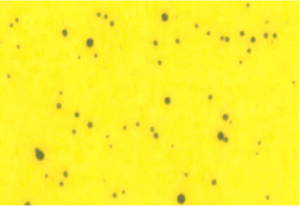
The hydrosensitive paper technique is a method described in various internationally relevant standards and codes, such as the Cooling Tower Institute’s Isokinetic Drift Test Code ATC 140 in the United States. It is classified as a sensitive-surface method and is based on the inertial impact of water droplets on a chemically treated surface. When a droplet impacts the paper, a blue stain is produced that contrasts with the paper’s yellow background, and its size is proportional to the velocity, size and angle of incidence of the original droplet. (Image 1)
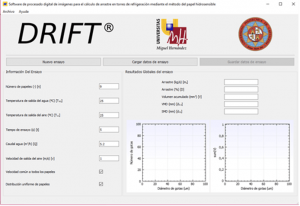
One of the specific lines of work developed by the Energy and Mechanics Unit of the Elche Engineering Research Centre focuses on preventing the proliferation of legionellosis through drift measurement in cooling towers. To this end, digital image processing software has been developed for the automatic detection, classification and quantification of droplets emitted by a cooling tower. (DRIFT, Image 2)
The hydrosensitive papers are exposed to the cooling tower’s outlet air stream for a specified period in order to obtain the largest possible number of samples without the stains overlapping. They are then scanned at high resolution (4800 dpi) and loaded into the software. The software extracts the information from the papers (stains), processes it and calculates the drift corresponding to each exposed paper.
Image 3 shows, as an example, the results window for a paper exposed in the outlet section of a cooling tower. The software can recognise and classify the detected stains according to predefined parameters that take into account the characteristics of the cooling tower. This process requires prior calibration based on the type of droplets emitted by the cooling tower. The technically viable measurement range for this type of technique is between 0.000002 and 0.0025 kg/(s m2).
One of the main advantages of the measurement method over other methods is its ability to provide both quantitative and qualitative results. In this respect, Image 4 shows the distribution of droplets recorded at the outlet of a cooling tower in the form of a histogram. Thus, it is possible to determine not only how much water leaves the tower but also the size of the droplets. This makes it possible to estimate the environmental impact of the equipment more accurately, since certain droplets of a particular size may be especially harmful to human health.
TECHNOLOGY APPLICATIONS
The knowledge described here falls within the field of heat-dissipation systems based on evaporative cooling (cooling towers), for both air-conditioning and industrial applications. Three sectors have therefore been identified as potential users of this knowledge:
- Cooling tower manufacturers (component design stage for this equipment).
- Companies responsible for the maintenance of air-conditioning services (auditing, component replacement, etc.).
- End users (ensuring compliance with regulatory requirements).
ADVANTAGES AND INNOVATIVE ASPECTS
The Energy and Mechanics Unit of the Elche Engineering Research Centre has extensive experience (more than 15 years) in measuring drift in cooling towers using the hydrosensitive paper method.
The scientific literature has shown that there is no single dominant method for measuring drift. Sensitive-surface methods for measuring drift in cooling towers are referred to in various international standards and codes. These methods are considered suitable for low and medium drift rates. This is why reference has only been made to air-conditioning and industrial applications. The advantages of sensitive-surface methods over other methods include:
- Cost. Hydrosensitive papers are relatively inexpensive compared with any device used for drift measurements (namely, isokinetic methods or laser-based techniques).
- Portability. The method allows measurements to be carried out on site, requiring only a scanner and a computer, which do not necessarily have to be located in the measurement area.
- Ability to provide distributions of the number and size of drift droplets.
DEVELOPMENT STAGE
The knowledge offered is available for application. It has previously been used in various research projects and service activities for companies.
APPLICATION SECTORS
- Air-Conditioning and Industrial Refrigeration Companies.
- Manufacturers of Evaporative Cooling Equipment.
- Healthcare and Tourism Sector (Large facilities with cooling towers).
- Environmental Engineering and Consultancy.
PRINCIPAL INVESTIGATOR
Javier Ruiz Ramírez – University Institute for Research in Engineering (I3E)