Binary Parallel Crawler-Type Locomotion Robot
Highly robust, low-power robotic system for movement across surfaces using discrete-state actuators and advanced-geometry joints.
 |
 |
TECHNOLOGY DESCRIPTION
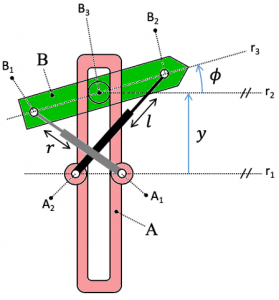
This device is a mobile robot designed to move across a plane with two degrees of freedom using a simplified yet highly efficient mechanical configuration. It consists of two bodies articulated through a “pivot-in-slot” joint, controlled by just two binary (on-off) linear actuators.
The system stands out for two key innovations:
-
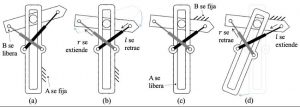
Bio-inspired Locomotion: It uses a “crawler-type” movement. The cycle consists of fixing the rear section, extending the body, fixing the front section (releasing the rear section), and retracting the body. This sequence enables effective and stable movement across horizontal or vertical surfaces.
-
Singularity-Free Multi-State Geometry: Thanks to its design, the robot can achieve 8 different postures using only 2 actuators. While a conventional robot is limited to $2^n$ postures (where $n$ is the number of actuators, resulting in 4 for $n=2$), this model doubles that capacity ($2 \times 2^2 = 8$). In addition, it can switch between the two postures of the same state without passing through uncontrollable configurations (singularities).
TECHNOLOGY APPLICATIONS
Possible non-exclusive applications of the proposed robot include its use as a climbing robot for inspection and maintenance tasks at height on vertical concrete or steel structures, avoiding the need for human operators to carry out these hazardous tasks, which involve the risk of falling from the structure and suffering serious injuries. The compactness of the proposed robot and its high mobility using a reduced number of actuators make it particularly suitable for the aforementioned tasks, as well as for any other task requiring movement along flat vertical or horizontal surfaces or surfaces with any other spatial orientation.
ADVANTAGES AND INNOVATIVE ASPECTS
-
Mechanical Efficiency: Achieves the same number of postures as other robots while saving a complete actuator, resulting in a direct reduction in weight, cost, energy consumption and control complexity.
-
Robustness and Simplified Control: By using binary actuators (only fully extended or fully retracted states), the system is highly robust to precision-related failures and easier to programme.
-
Enhanced Stability: The arrangement of the actuators and the type of joint provide high structural rigidity, allowing the workspace to be safely expanded.
-
Overcoming Singularities: It can transition between different geometric configurations for the same actuator extension without losing controllability, addressing a common problem in parallel robotics that this design effectively overcomes.
DEVELOPMENT STAGE
It is currently in the laboratory prototype construction phase. The mathematical and kinematic models have already been validated, and the physical prototype will be used to demonstrate the operational advantages in real-world test environments.
APPLICATION SECTORS
- Civil Engineering and Construction.
- Energy Sector (Wind, Solar and Petrochemical).
- Aerospace and Naval Industry.
- Technical Inspection and Non-Destructive Testing (NDT) Companies.
- Service Robotics Manufacturers.
PRINCIPAL INVESTIGATOR
Oscar Reinoso García – University Institute for Research in Engineering (I3E)