SAFEST: A Gamified Safety Incident Reporting System for Healthcare Students
Web-based tool for safety incident reporting by healthcare students during placements in healthcare settings. To promote cooperative learning, SAFEST incorporates a peer assessment process for submitted reports, with the results linked to virtual and academic rewards. This provides students with feedback on their reports, enabling them to learn from others.
 |
TECHNOLOGY DESCRIPTION
SAFEST is a platform designed to enable students in healthcare disciplines (Nursing, Medicine, etc.) to report safety incidents detected during their clinical placements. According to the WHO, an incident is defined as any event that could have caused or did cause unnecessary harm to a patient.
The technology operates through a structured digital ecosystem:
-
Registration and Dashboard: Students access a personal dashboard where they manage their reports and assessments. Register here.
-
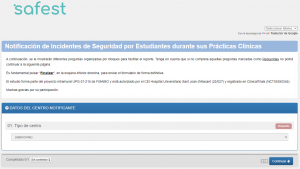
Incident Reporting Form: A system adapted from professional standards that requires students not only to describe the error, but also to analyse its root causes and propose preventive or corrective measures.
-
Peer Learning (Peer Assessment): Anonymously, students assess their peers’ reports, providing feedback on the usefulness of the information and the feasibility of the proposed solutions.
-
Gamification and Rewards: The system encourages participation through virtual and academic rewards, such as credits for UMH Nano-courses.
Video user guides:
TECHNOLOGY APPLICATIONS
SAFEST is primarily intended as a learning tool, so its main field of application is education, specifically institutions offering healthcare-related programmes that also include placements in healthcare settings. Therefore, the main application sectors for the technology developed are the academic and healthcare sectors.
The patient safety research networks in which SAFEST’s promoters participate at national, pan-European (ERNST Consortium) and Latin American (LATAM) levels facilitate the transfer of the technology to the education sector and also to the healthcare sector through the healthcare institutions linked to the participating educational institutions in the different networks.
ADVANTAGES AND INNOVATIVE ASPECTS
To the best of our knowledge, SAFEST is one of the first initiatives to adapt traditional safety incident reporting systems to the specific needs of students in healthcare disciplines and to incorporate gamification for cooperative learning purposes. We are only aware of one similar proposal that uses game-based features (escape room) to simulate risk situations that culminate in incident reporting among residents (Zhang et al., 10.7759/cureus.4014).
The main advantages or distinctive features of SAFEST are:
- A tool adapted to the learning needs of students in healthcare disciplines (rather than residents or healthcare professionals).
- Allows participation in teams of two to three students.
- Not limited to analysing the causes of the incident (immediate and latent), but also incorporates the proposal of preventive or corrective measures (solution-oriented approach).
- Provides and enables feedback on submitted reports through a peer assessment process.
- A gamified approach that allows students to obtain rewards in the form of academic credits and access to other direct rewards.
DEVELOPMENT STAGE
Pilot Study Phase: The tool currently has a first operational version undergoing validation with students in Spain and Latin America. It is in the process of expanding to other European educational institutions.
APPLICATION SECTORS
- Academic Sector (Universities and Health Schools).
- Healthcare Institutions Linked to Educational Institutions.
- Patient Safety Research Networks.
PRINCIPAL INVESTIGATOR
Irene Carrillo Murcia – Department of Health Psychology