In silico Permeability Study of Bioactive Compounds Through Biomembranes
The analysis is carried out using a bioinformatics model, developed by researchers at IDiBE, to assess the permeability of organic compounds through simple and complex biomembranes, such as bacterial membranes and artificial skin systems, aimed at characterising and optimising bioactive compounds for the pharmaceutical,
 cosmetics and biotechnology industries.
TECHNOLOGY DESCRIPTION
The drug development process, as well as the development of any other new chemical entity, is a lengthy and costly process subject to numerous legal requirements and standards before entering the market. Success rates in drug development are extremely low (around 95% of candidates fail before reaching the market). The use of bioinformatics tools can minimise costs and risks in these types of models, accelerating various processes and reducing development costs and time compared with in vivo or in vitro techniques.
The technology offered consists of a bioinformatics model designed to characterise the permeability of organic compounds through different biomembrane model systems with varying compositions and levels of complexity, equivalent to those found in real-world applications (whether at the human or bacterial level, for example).
Using this bioinformatics tool, companies can characterise the permeability properties of their compounds under development through different biomembrane models, thereby maximising the likelihood that these compounds will reach the cellular compartment where they need to exert their activity and, conversely, verifying that they are unable to permeate barriers or compartments where they could have toxic effects.
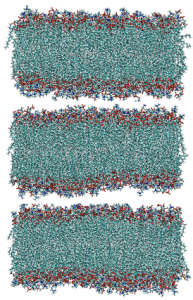
The technology offered makes it possible to create complex membrane systems, such as the membrane system found in human skin (stratum corneum), characterised by the stacking of biomembranes on top of one another and by a highly specific lipid composition found only in this tissue. This makes it possible to determine the permeability of bioactive substances through this membrane system by comparing them with one another, as well as with standards used in the pharmaceutical industry.
The use of in silico techniques, such as molecular dynamics simulation and system construction, enables the characterisation of the dynamics of macromolecules and ligands in a native environment, including proteins, lipids, water and ions. In this way, the tool enables characterisation in complex membrane systems with a defined lipid composition that simulates specific cellular compartments (plasma membrane, organelle membranes, bacterial membranes and skin), thereby providing a comprehensive characterisation of compound permeability in systems that closely resemble natural systems.
For this purpose, we have a high-performance computing cluster consisting of CPU/GPU units with dedicated management and editing software, maintained and available 24 hours a day, 7 days a week.
TECHNOLOGY APPLICATIONS
This technology is useful for any type of industry involved in the development of bioactive compounds that may interact with biological membranes during their life cycle, whether of human, animal or bacterial origin, among others, as well as with any subcellular compartment.
These industries include the pharmaceutical, veterinary, cosmetics, cosmeceutical and nutraceutical industries, as well as any type of chemical industry interested in analysing the permeability of its developments through the skin, plasma membrane or any other type of biological membrane.
ADVANTAGES AND INNOVATIVE ASPECTS
The use of this technology makes it possible to:
- Improve cost-effectiveness in drug development.
- Perform high-throughput screening.
- Reduce development times.
- Identify “drug-like” candidates in silico prior to laboratory testing.
- Reduce the use of experimental animals.
DEVELOPMENT STAGE
Fully operational. The tool has been developed and validated by researchers at IDiBE. It is available for immediate implementation following an initial phase to define objectives with the interested company.
APPLICATION SECTORS
- Pharmaceuticals and Human/Animal Health.
- High-End Cosmetics and Personal Care.
- Industrial Biotechnology.
- Chemical and Advanced Materials Industry.
PRINCIPAL INVESTIGATOR
José Villalaín Boullon – Institute for Research, Development and Innovation in Health Biotechnology of Elche