Brain–Machine Interface for Controlling Robotic Exoskeletons
A system that, based on the recording and processing of electroencephalographic (EEG) signals, enables the movement of upper- or lower-limb robotic exoskeletons to be controlled.
 |
TECHNOLOGY DESCRIPTION
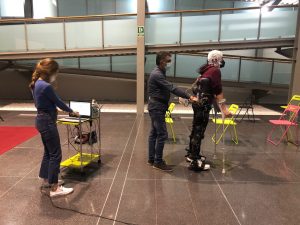
The brain–machine interface records the person’s EEG signals using surface electrodes and processes these signals to detect brain patterns associated with imagining upper- or lower-limb movements or with a relaxed state. Depending on the brain pattern detected by the brain–machine interface, a command is sent to control the movement of the robotic exoskeleton. The image below shows a brain–machine interface developed to control the gait of a lower-limb exoskeleton.
TECHNOLOGY APPLICATIONS
The main application of this knowledge would be in clinical settings, where it could be used as a rehabilitation and assistive tool for patients with motor impairments.
ADVANTAGES AND INNOVATIVE ASPECTS
Stroke and spinal cord injury are two of the main motor disorders caused by damage to the human nervous system that lead to physical impairment in Western societies. They may result in permanent pathological gait and, consequently, impaired independent ambulation. Recent advances in robotic technologies have led to the development of lower-limb robotic exoskeletons as mobility aids for individuals with motor impairments [1].
Interaction between robotic exoskeletons and users is generally implemented through a combination of mechanical and electrical devices. Although effective, these interfaces are not the means that humans naturally use to interact [2]. Furthermore, the usability and clinical relevance of these robotic systems could be further enhanced through brain–machine interfaces [3], opening the door to the use of these systems in the rehabilitation of patients with motor impairments. In this regard, it is worth highlighting that the research group has extensive experience in this field [4–6].
[1 ] J.L. Pons, Wearable robots : biomechatronic exoskeletons. (Wiley, 2008).
[2] Y. David Li, E.T. Hsiao-Wecksler, Gait mode recognition and control for a portable-powered ankle-foot orthosis. in IEEE International Conference on Rehabilitation Robotics 1–8 (IEEE, 2013). doi:10.1109/ICORR.2013.6650373
[3] Y. He, D. Eguren, J. M. Azorín, R. G. Grossman, and T. Phat Luu, “Brain–machine interfaces for controlling lower-limb powered robotic systems Brain-Machine Interfaces for Controlling Lower-Limb Powered Robotic Systems,” J. Neural Eng., vol. 15, no. 2, p. 021004, Apr. 2018.
[4] L. Ferrero, V. Quiles, M. Ortiz, E. Iáñez, J.M. Azorín, 2021, A BMI based on motor imagery and attention for commanding a lower-limb robotic exoskeleton: a case of study, Applied Sciences, 11(9), 4106: 1-14.
[5] M. Ortiz, L. Ferrero, E. Iáñez, J.M. Azorín, J.L. Contreras-Vidal, 2020, Sensory integration in human movement: a new brain-machine interface based on gamma band and attention level for controlling a lower-limb exoskeleton, Frontiers in Bioengineering and Biotechnology, 8:735: 1-16.
[6] M. Marisol Rodríguez-Ugarte, Eduardo Iáñez, Mario Ortiz, Jose M. Azorin, «Improving real-time lower limb motor imagery detection using tDCS and an exoskeleton”, Frontiers in Neuroscience, vol. 12:757, p. 1-12, Oct. 2018.
DEVELOPMENT STAGE
Usability tests have been carried out with healthy users and a limited number of patients. Work is currently underway to reduce the number of electrodes used to acquire EEG signals and to develop methods that enable self-calibration of the brain–machine interface’s signal-processing algorithms.
APPLICATION SECTORS
- Hospitals and Neurological Rehabilitation Centres.
- Medical and Assistive Robotics Industry.
- Biomedical Engineering Research Centres.
- Digital Health (E-Health) Device Development.
PRINCIPAL INVESTIGATOR
José María Azorín Poveda – University Research Institute for Engineering