An Integrative Methodology for Developing Strategic Innovation in Organisations
A technology or methodology combining different tools to develop and accelerate the strategic innovation competence of emerging, growing and mature organisations.
 |
TECHNOLOGY DESCRIPTION
The proposed methodology is based on previous studies that identified the competencies relevant to different types of innovation. It is described as integrative because it incorporates best practices from different models that have proved effective in various areas of the business environment, such as Dyer, Gregersen and Christenson’s *The Innovator’s DNA* (2011); Lean Startup (Ries, 2011); the Blue Ocean Strategy model (Kim & Mauborgne, 2015); Design Thinking tools (Simon, 1969); the agile methodology for developing innovative projects, *Sprint* (Knapp, 2016); and others, such as the Nominal Group Technique (Delbecq, 1984).
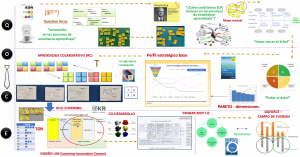
The tool combines different phases that use the competence of questioning alongside observation, connection and experimentation, in a collaborative, multi-step model designed to increase participants’ ability to produce innovative results in any field, as illustrated below.
One of its strengths is its ability to generate disruptive results in a very short period, ranging from a few days to a few weeks.
TECHNOLOGY APPLICATIONS
If the proposed integrative methodology is validated technically, economically, commercially and technologically, the expected benefits of applying this knowledge include facilitating product creation in companies at an early or growth stage, and process creation in mature companies. It is intended for situations in which organisations need to identify innovative ideas, develop them within a short period and test prototypes to validate their hypotheses before launching them on the market, thereby optimising time and resources.
This is a cross-cutting methodology, meaning that it can be applied to any sector or project, in both the services and industrial sectors and in public or private organisations. However, it would be easier to implement in environments with young, flexible cultures, where levers for change are easier to identify and there are fewer constraints, as may be the case in contrast to a public body subject to legal and procedural restrictions.
ADVANTAGES AND INNOVATIVE ASPECTS
Its main advantage lies in the power derived from combining the best tools in organisational innovation with proven innovation models, arranged into a framework that can deliver high-impact results in a very short time.
Another strength of this technology is that it is not merely the result of a theoretical compilation of best practices. Its authors have applied these practices directly in numerous professional and academic contexts.
For example, before joining academia, the first author spent several years in the private sector testing various tools included in the integrative technology across different projects. One example was their application to the continuous improvement of a multinational services organisation as part of an organisational transformation project using the Lean Management methodology. The project involved different organisational areas and groups of managers and frontline staff over several years, and received public recognition, including the 2017 national LEAN COMMUNITY award in the “First Steps Towards Excellence” category.
In a different field, demonstrating the methodology’s broad applicability, some of its tools were used in a health improvement project that established “health circles” to promote healthy habits in another mixed public-private company in the Mediterranean region. This initiative received an honourable mention in the 2017 Escolástico Zaldívar Award in Madrid, presented by Fraternidad-Muprespa, and was also a finalist for the Healthy Organisations Award organised by the Human Resources Observatory in Madrid in 2018.
It is also worth noting that several of the tools incorporated into this technology originated in academic and research experiences. One example is the project led by the first author, “Developing Innovation Competencies to Foster Entrepreneurial Spirit in Higher Education Students”, under the INNOVATION NETWORKS programme at the University of Alicante in 2019. This project demonstrated the effectiveness of the questioning tool known as the Question Formulation Technique in generating innovative ideas.
Finally, the authors’ publications and conference contributions show that this topic has been under development for several years and that the results are promising. However, resources need to be allocated to testing the technology in a wider range of settings, with greater investment of time and more in-depth experimentation, in order to fully realise the potential of the proposed tools.
DEVELOPMENT STAGE
The methodology has been tested with working groups and adjustments have been made. It is ready for implementation on a larger scale in organisations seeking profound transformation.
APPLICATION SECTORS
- Industrial and Services Sectors.
- Public and Mixed Organisations (seeking to streamline processes and services for citizens).
- Healthcare and Risk Prevention Sector.
- Strategy and Digital Transformation Consultancies.
PRINCIPAL INVESTIGATOR
José Manuel de Haro García – Department of Economic and Financial Studies